
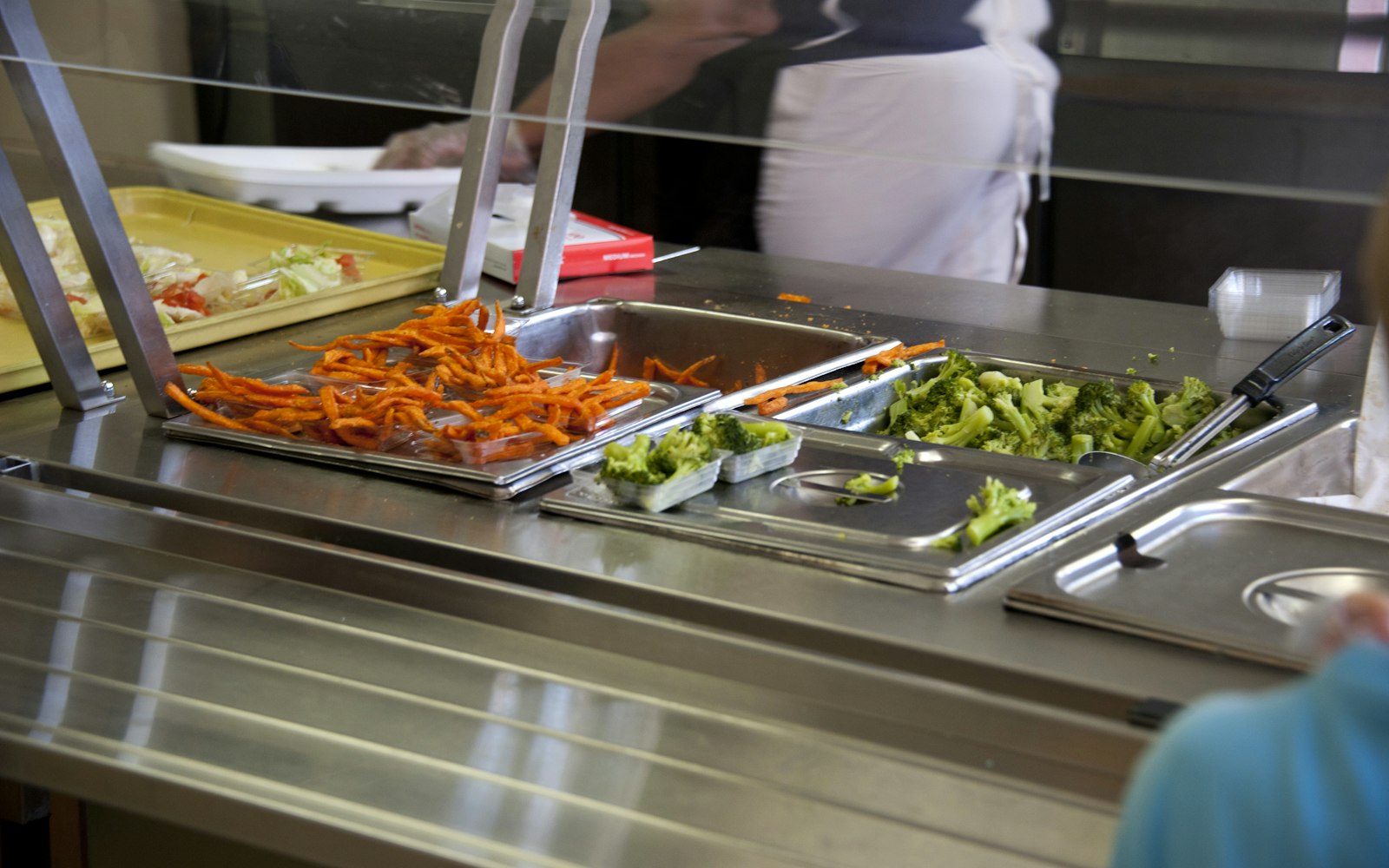
Any establishment that serves food to large numbers of people every day inevitably faces the same problem: a constant stream of organic waste that needs to be stored, refrigerated and paid to have removed. What varies from sector to sector is not so much the volume as the associated restrictions.
Catering and hospitality
Food waste comes in two waves — food preparation and service — and comprises a wide variety of items: vegetables, bread, protein and, depending on the menu, shellfish shells, which are among the slowest to digest.
The typical restriction here is the space. Many city-centre kitchens have neither a proper waste collection area nor a loading bay. And there is one factor that does not appear in any spreadsheet but which weighs heavily in the decision: in a catering establishment, the smell from the waste area and the presence of insects are a reputational issue, not just a hygiene one.
Continuous feeding fits in well with this rhythm: it is fed throughout the shift, without waiting for batches to be completed.
Hotels and resorts
Much higher volumes that are highly seasonal: a resort’s energy generation can increase fivefold between the low and high seasons. This makes it difficult to base calculations on average figures.
Here is the plot of the odour control It is particularly effective because the service area is usually close to customer areas. The built-in sensor, which detects unpleasant odours and activates automatic deodorisation, is designed precisely for situations like this.
And in chains with several properties, the cloud-based monitoring It is no longer just a bonus but has become the main reason for purchase: it allows you to view the hourly, daily and monthly performance of all equipment from a single dashboard, and to diagnose faults remotely without needing to send anyone out.
Hospitals, care homes and care centres for the elderly
Production is very consistent and predictable, with three daily collections. The manure tends to be soft and watery, which is the type that is digested most quickly.
The dominant constraint is the hygiene. In a healthcare setting, reducing the amount of stored organic waste and eliminating the associated pest vectors is not merely an operational improvement: it is a necessity. The fact that the process leaves no solid waste to manage greatly simplifies protocols.
The fact that the cycle runs continuously and odour-free means that the appliance can be placed near the kitchen without causing any problems.
Schools, universities and canteens
Very intensive study sessions — one or two hours a day — and a timetable with long breaks. There are two particular features here:
- The waste is mainly uneaten food, with plenty of vegetables and starchy foods. Quick overview.
- High risk of them falling cutlery in the waste when the trays are emptied. The detection of hard and metallic objects using the current-to-weight ratio is designed precisely for this purpose.
In schools, there is also an educational aspect: a device that turns food waste into water serves as a practical demonstration of a concept taught in class.
Supermarkets and the food industry
A different scenario to that of a kitchen: fresh produce withdrawn due to expiry, in large and fairly uniform quantities. Fruit and vegetables, above all, as these are digested most quickly.
In industry, consistency is an advantage: when the same type of material is always fed into the digester, its behaviour is highly predictable.
Shipbuilding sector
This is the case where the constraint is not economic but legal: The MARPOL Annex V Convention drastically restricts the discharge of waste from ships in coastal waters and special areas. On board, there is no option to store waste indefinitely or to call in a waste management contractor.
For this application, there is a marine-grade version made from AISI 316 stainless steel, which is more resistant to corrosion than the standard AISI 304.
What they all have in common
Looking beyond the differences, the calculation is the same in all six cases: there is a recurring cost per kilo collected, the space occupied, the energy used for refrigeration, and the number of staff hours spent moving waste. It is the weight of each consignment that varies, not the list itself.
If you’d like to find out how this applies to your situation, please tell us your sector and your approximate daily volume at the contact form.
